
Skip to content

Wardrobe designs for your bedroom — premium ideas, real costs

Ideas we have tested on real wardrobes in Bangalore — how each one is made, what it actually costs, and where it is worth the money.

Grooved veneer wardrobe

A wardrobe that looks custom-made and expensive — real wood veneer with CNC-grooved arch lines and a polished finish — for about ₹16,000 more than a plain laminate wardrobe.
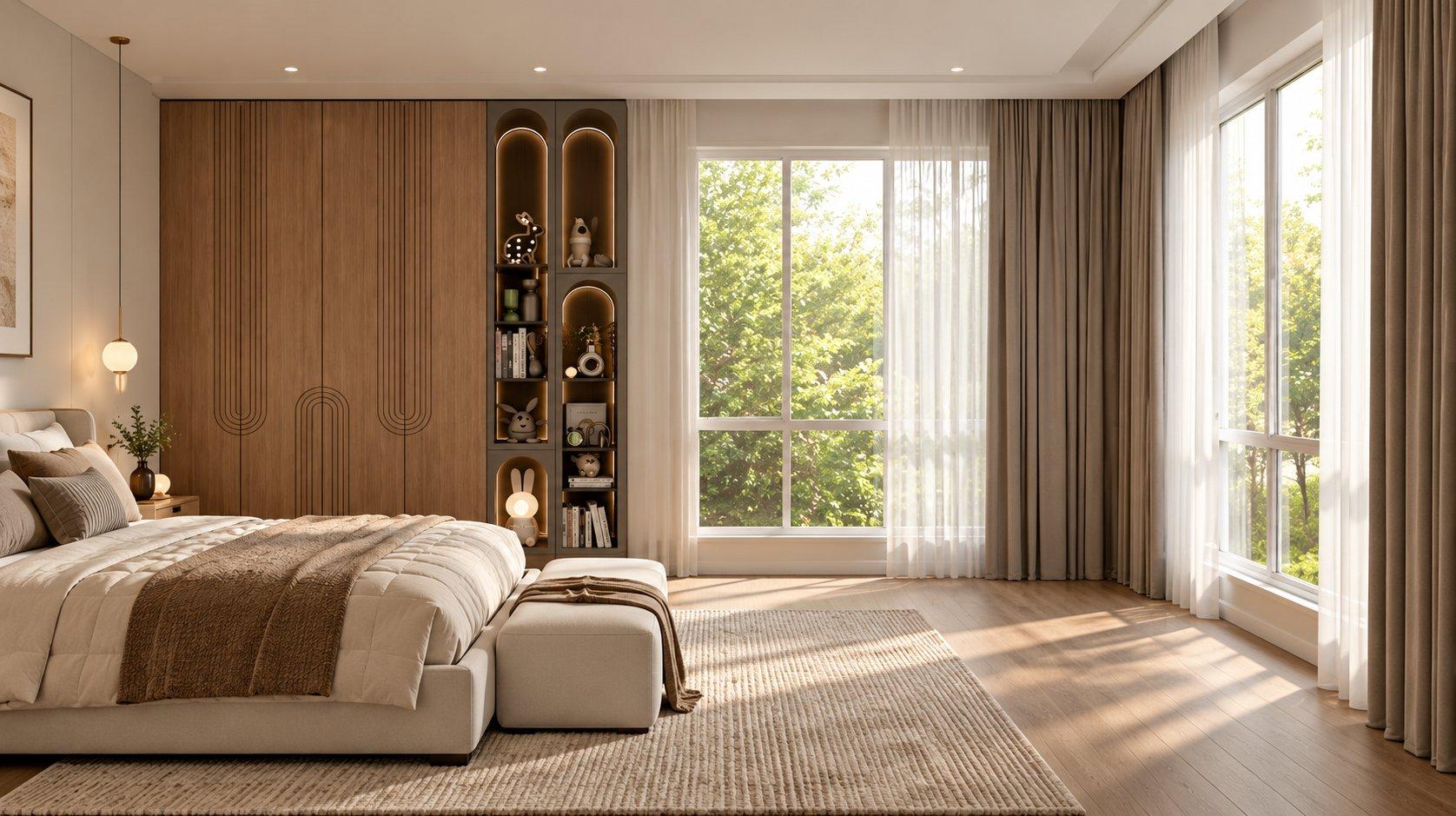
2026 wardrobe design idea: wood veneer wardrobe with CNC-grooved arch lines beside lit arched open shelves in a bright bedroom — Willow Interiors concept render
Concept render · Willow Interiors, 2026

Is veneer more expensive than laminate for wardrobes?

Not necessarily. For a wardrobe, a good veneer sheet (8 × 4 ft) costs about ₹2,000–2,500 — in the same range as a branded laminate like Century or Merino, which costs ₹1,500–3,200 a sheet.

Regular 1 mm laminate from standard brands costs ₹1,200–1,600 a sheet, and the most basic laminates start at ₹800–900. Veneer can go up to ₹10,000–20,000 a sheet, but you do not need that for a premium-looking wardrobe.

The veneer we use for wardrobe shutters is 4 mm or 6 mm thick, pasted on block board.

How much more does a veneer wardrobe cost than a laminate wardrobe?

About ₹200 per sq ft more than a plain laminate wardrobe — including the veneer, CNC grooving and polish. For an 8 ft wide, 10 ft high wardrobe (80 sq ft, loft included), that is roughly ₹16,000 extra.

CNC grooving is charged on the grooved design area at about ₹150–200 per sq ft, and costs the same whether the shutter is veneer or laminate. Veneer polish costs about ₹80–120 per sq ft.

What makes a veneer wardrobe look premium?

Use veneer instead of laminate, add a CNC-grooved pattern, make the loft handle-less, and choose designer handles. Together these make a wardrobe look custom-made for a small extra cost.

  • Veneer instead of laminate — real wood grain that joins seamlessly across shutters, in many shades.
  • CNC-grooved patterns, like arch lines, cut by machine for clean, even depth.
  • A seamless, handle-less loft with push-to-open fittings — the wardrobe reads as one tall, continuous piece.
  • Designer handles — concealed or long wooden handles change the whole look.

Is veneer durable enough for a wardrobe?

Yes — veneer is absolutely usable for wardrobes. It is natural wood, so it scratches more easily than laminate; that makes it a good choice for wardrobes but a poor one for kitchens.

Veneer may need re-polishing over the years. How soon depends mostly on the quality of the polish and how many coats were applied, not on the veneer itself — even polished teak can peel when the polish is poor.

Does veneer work for sliding wardrobes?

Yes. Veneer works for hinged, sliding and loft shutters, at any size — it comes in different sheet sizes and joins seamlessly, so the grain can flow across a wide wardrobe.

Cost at a glance

Basic laminate (per 8 × 4 sheet)₹800–900
1 mm laminate, regular brands₹1,200–1,600
Branded laminate (Century, Merino)₹1,500–3,200
Veneer, right grade for wardrobes₹2,000–2,500
CNC grooving (per sq ft of design area)₹150–200
Veneer polish (per sq ft)₹80–120
Extra over a plain laminate wardrobe≈ ₹200 per sq ft
Example: 8 ft × 10 ft wardrobe (80 sq ft)≈ ₹16,000 extra

Bangalore prices, October 2026. Material prices vary by brand and design.
Layered overlay wardrobe

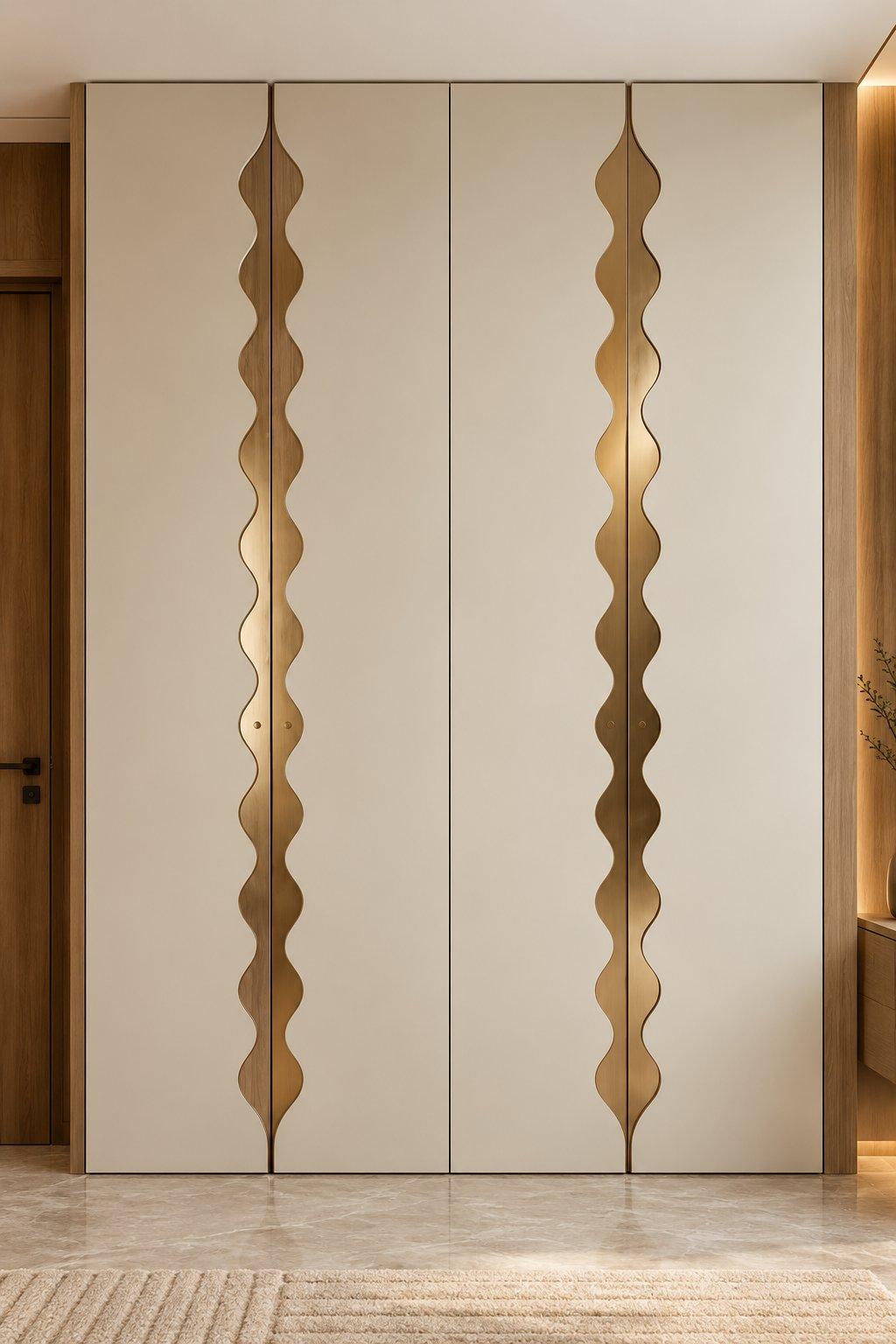
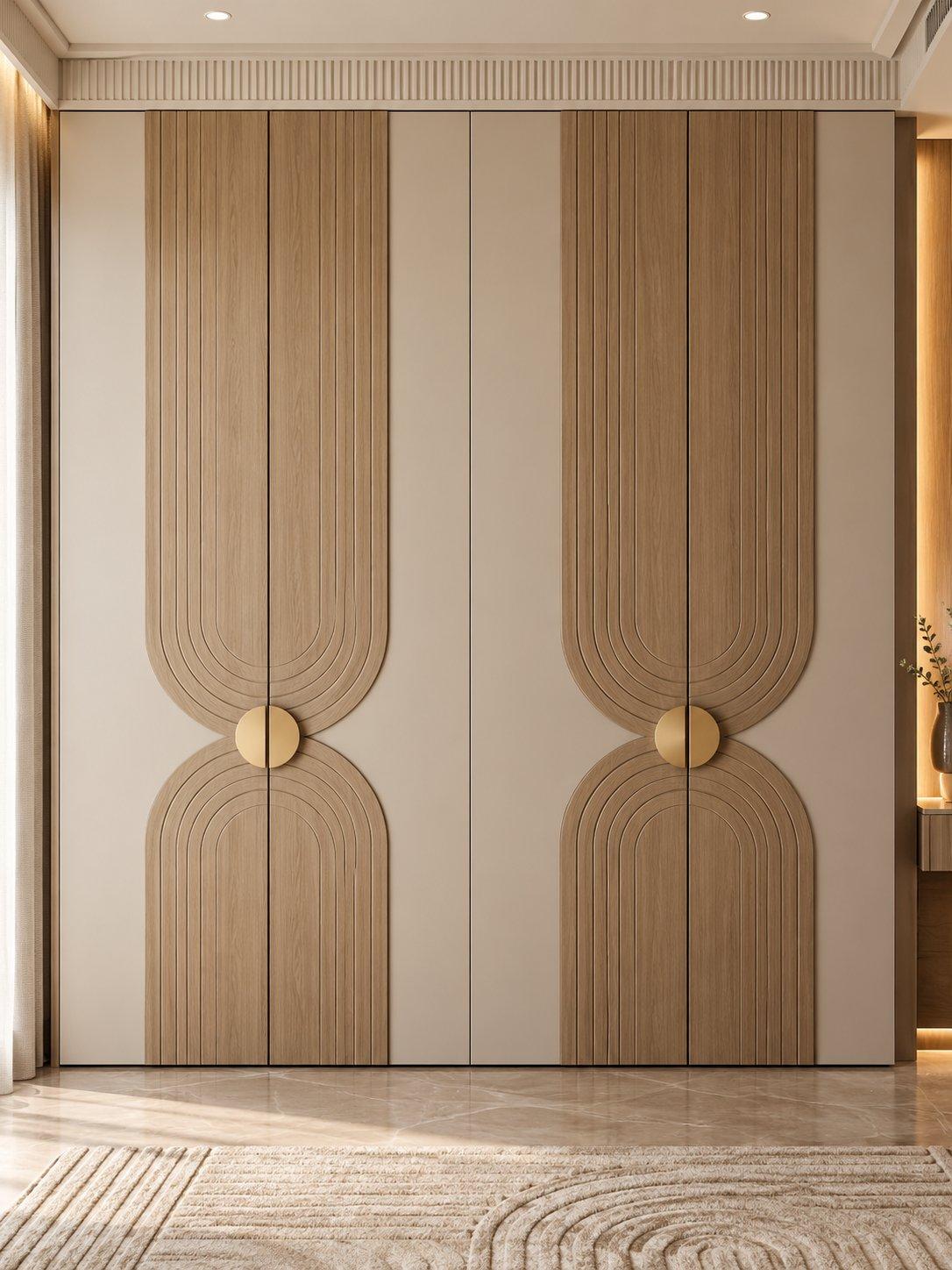
A second, shaped layer fixed on top of regular laminate shutters — arches, waves or any pattern — that runs into the loft so the wardrobe looks taller and the room larger. Usually about ₹10,000–12,000 extra.

2026 wardrobe design idea: cream wardrobe with grooved wooden arch overlay panels and round brass handles, running into the loft — Willow Interiors concept render
2026 wardrobe design idea: cream floor-to-ceiling wardrobe with bronze wave-shaped overlay panels along the shutter joints — Willow Interiors concept render
Concept render · Willow Interiors, 2026

What is a layered (overlay) wardrobe design?

It is a regular laminate wardrobe with a second, thinner layer fixed on top of the shutters — cut into a shape such as arches or waves. It gives the depth and detail of a custom-made designer wardrobe at one of the lowest costs.

The top layer can be laminate or veneer, and can have grooves or any pattern cut into it. It works on any shutter.

How is an overlay wardrobe shutter made?

The overlay shape is cut from a thin 6–10 mm board, faced with laminate or veneer, and bonded onto the shutter wherever the laminate underneath has been cut away to expose raw board.

  • Cut the overlay shape from 6–10 mm HDHMR (or MDF), faced with laminate or veneer.
  • Add grooves or a pattern if the design needs it, and finish the edges with edge banding or a PU / Duco coat.
  • On the main shutter, cut away the laminate exactly where the overlay will sit, so raw board meets raw board.
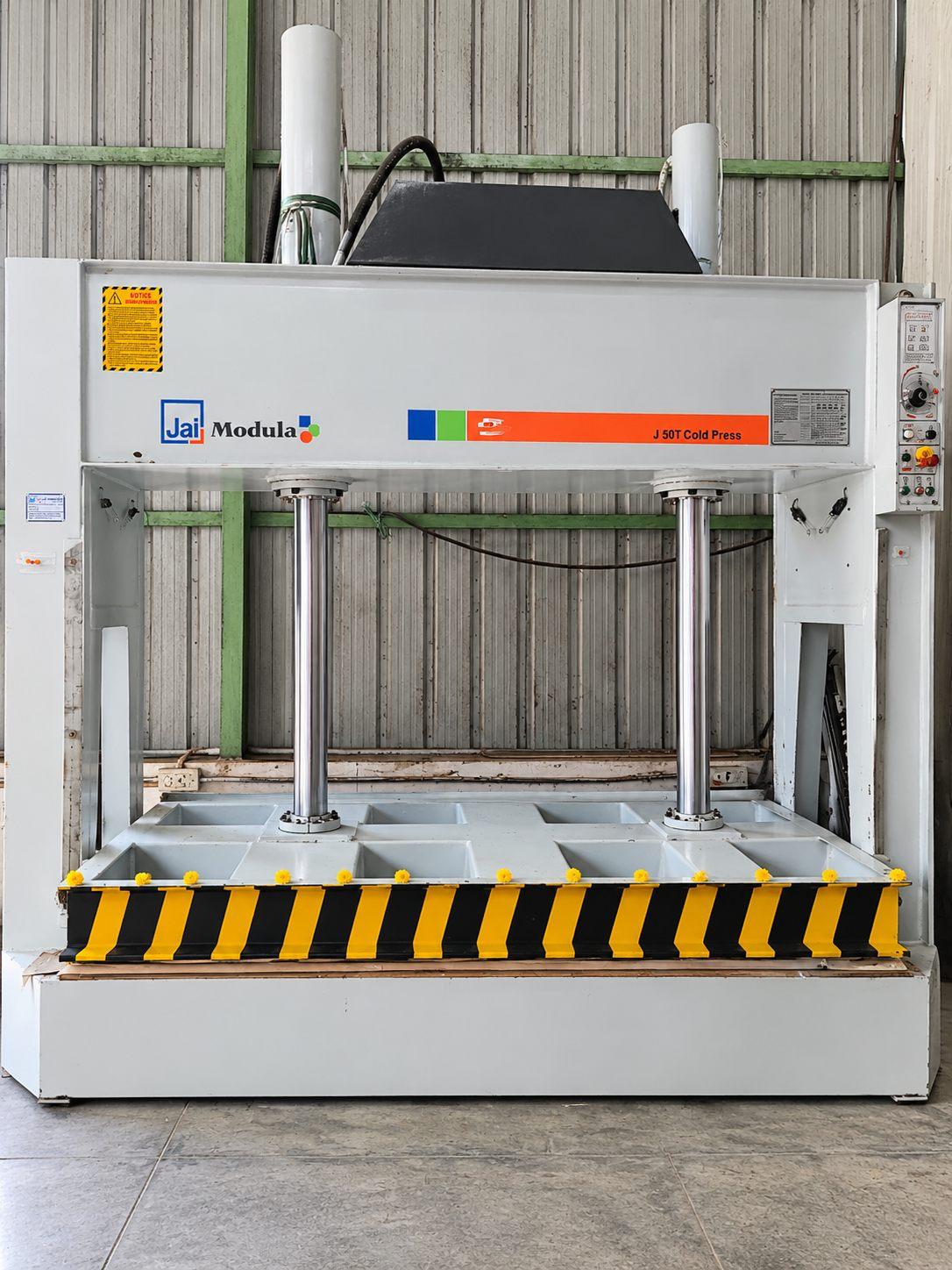
  • Bond the two together in a cold press or hot press.

How much does an overlay wardrobe design cost?

Usually about ₹10,000–12,000 more than the same wardrobe without it, because most designs need only one extra board plus laminate or veneer and the work to make and fix it.

The exact cost depends on the design and the size of the overlay — a larger or more detailed pattern costs more.

Can a wardrobe with a loft still look tall and seamless?

Yes. Run the overlay design continuously from the shutters up into the loft, and the eye reads the wardrobe as one tall piece instead of two stacked boxes — the room looks taller, larger and more spacious.

HDHMR vs MDF: which is better for wardrobes?

HDHMR. It is essentially a better MDF — denser and stronger. For wardrobe carcasses and shutters, MDF is best avoided.

A thin overlay is the one place MDF also works, because it carries no load — as long as its exposed edges are well finished with edge banding or a good PU or Duco coat.

Will the overlay layer come off over time?

No — not when it is bonded raw board to raw board and pressed. The overlay is a small, thin piece, so glue alone holds it permanently.

Two things matter. It must never be glued on top of laminate — the laminate underneath is cut away first. And it must be pressed in a cold press or hot press. Never let it be stuck on with glue and tape at the edges on site.

Cold press machine used to bond laminate evenly onto boards at Willow’s manufacturing unit
The cold press at our manufacturing unit in Bangalore

What handles suit a designer wardrobe?

Handles that are part of the design — not random off-the-shelf ones. A standard handle breaks the pattern and cheapens the look.

  • For arch overlays: a round handle (wooden or metal) set where the arches meet.
  • For wave or curved overlays: no handle at all, or small knobs or pulls cut in the same shape as the pattern.

Cost at a glance

Overlay board6–10 mm HDHMR (or MDF), usually one 8 × 4 sheet
FaceLaminate or veneer
EdgesEdge banding, or PU / Duco
Typical extra for the wardrobe≈ ₹10,000–12,000

Bangalore prices, October 2026. Depends on the design and size of the overlay.

Printed laminate wardrobe

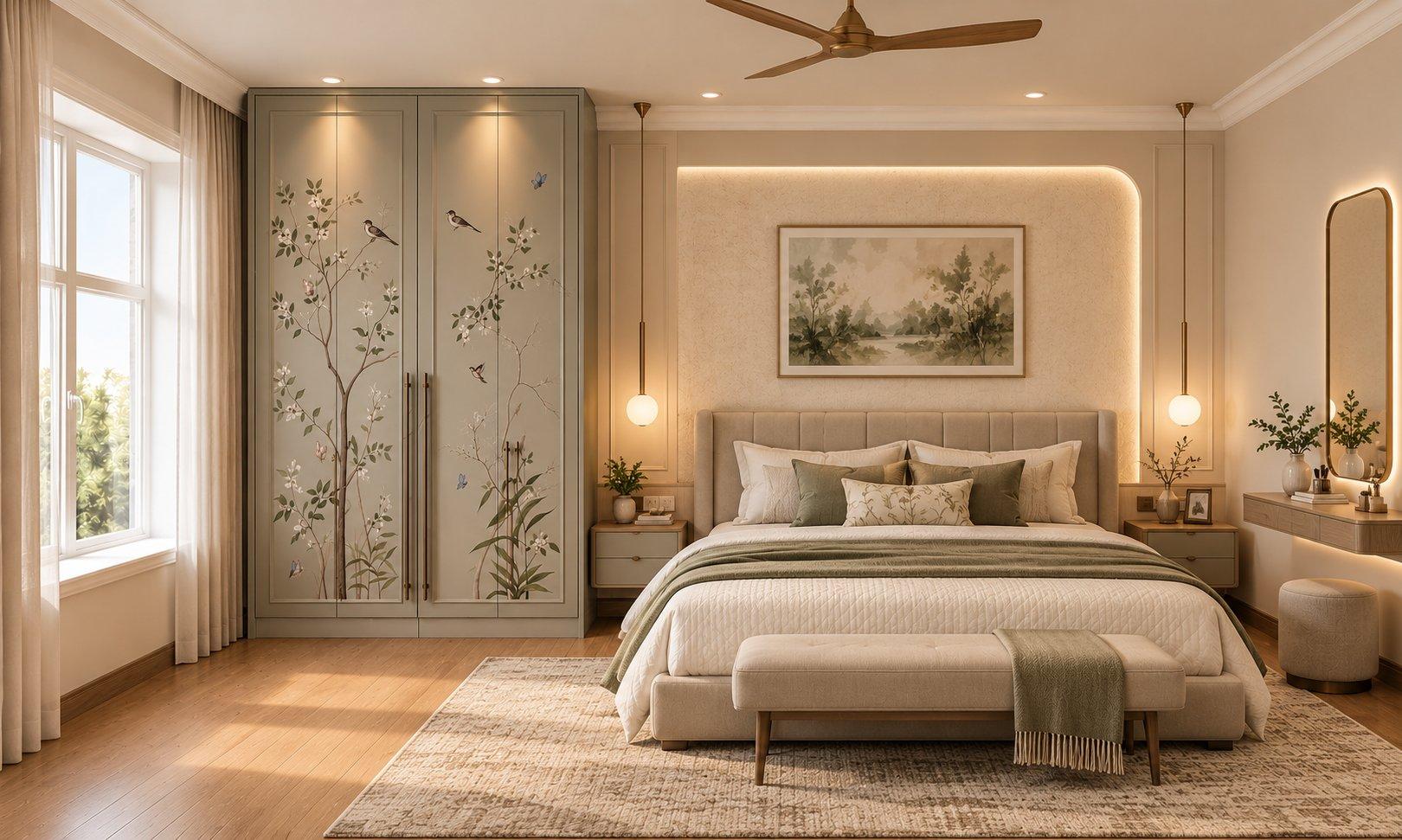
Any image — florals, birds, a favourite character, even your child’s photo — printed onto the laminate itself. One of the most pocket-friendly ways to make a wardrobe special: at most about ₹2,000 extra per sheet.

2026 wardrobe design idea: sage green wardrobe with custom floral and bird printed laminate in a calm bedroom — Willow Interiors concept render
Concept render · Willow Interiors, 2026

Can you get a custom print on wardrobe laminate?

Yes. Any image can be printed directly onto laminate and used on wardrobe shutters like a normal laminate. Printed designs are available ready-made at some designer laminate shops, and vendors can print any image you choose.

How much does custom printed laminate cost?

Not much — at the higher end, about ₹2,000 more per laminate sheet than the same laminate unprinted.

How much of a wardrobe should be printed?

Less than you think. Printing about 10–12% of the wardrobe front — a branch of flowers, a few birds — and leaving the rest in the laminate’s plain colour looks far more premium than printing every shutter edge to edge.

Light, airy prints such as florals work best. Heavy, busy prints across the whole wardrobe quickly feel loud.

How do you choose an image for a printed laminate?

Choose from the print vendor’s own stock image library — most share a link to a premium library such as Shutterstock, where images are high-resolution and fit for printing. The vendor downloads it at the size they need.

Always ask to see a printed sample first: the print should be sharp and seamless, never pixelated. Choosing the image can take a minute or a month — that part is up to you.

Does printed laminate fade?

It can, if the print is poor — how long it lasts depends on the quality of the base laminate and of the print. That is why it is best ordered through an interior company or vendor who prints laminates regularly and already knows which printers do it well.

Printed laminate or wallpaper on a wardrobe — which is better?

Printed laminate, any day. Wallpaper scratches and tears easily on something you open every day; printed laminate is still laminate — the most practical surface for a wardrobe.

What are good wardrobe design ideas for a kids’ room?

A printed laminate is one of the easiest: your child’s favourite characters, cars, animals or even their own photo printed on the shutters — on a durable, wipeable laminate surface.

How long does it take to get a laminate printed?

About a week for printing, once the image is chosen.

We arrange printed laminates through vendors we work with regularly, including for our B2B clients.

Cost at a glance

Custom printing, extra per 8 × 4 sheetUp to ≈ ₹2,000
Printing timeAbout 1 week
Recommended printed areaAbout 10–12% of the wardrobe front

Bangalore prices, October 2026.

Designer skirting and loft filler

The two strips everyone ignores — the skirting at the bottom and the filler above the loft — turned into the feature. Keep the shutters plain and let these pieces make the wardrobe unique, for about ₹1,000.

2026 wardrobe design idea: plain pastel wardrobe with CNC-cut circle pattern on the skirting and loft filler — Willow Interiors concept render
Concept render · Willow Interiors, 2026

What is skirting and loft filler in a modular wardrobe?

The skirting is the running strip along the floor under a wardrobe, usually about 100 mm high. The loft filler is the strip that closes the gap between the top of the wardrobe and the ceiling — needed only when the wardrobe goes up to the ceiling.

Because they are so plain, they are the most ignored parts of a wardrobe — which is exactly why designing them stands out.

How much does a designer skirting cost?

Very little — usually up to about ₹1,000 for a wardrobe. It needs only CNC cutting and a contrast backing panel, which can often be cut from a leftover piece.

The exact cost depends on the design.

What material is wardrobe skirting made of?

Usually the same material as the wardrobe carcass — commercial or MR-grade plywood.

How do you make a plain wardrobe look unique without changing the shutters?

Design the skirting and loft filler instead of the shutters. Keep the shutters in a plain, soft pastel laminate or PU, and give these two strips a pattern or contrast colour — the wardrobe instantly looks custom-designed.

How is a designer wardrobe skirting made?

The most refined way is to cut a pattern through the skirting and filler with a CNC machine, then back it with a second piece in a contrast colour so the pattern shows through.

Carved skirting finished in Duco or PU is not recommended — the skirting is touched every time the floor is swept and mopped, so a carved, painted finish wears out quickly.

  • CNC-cut pattern with a contrast-colour backing — circles, waves, any shape.
  • Textured or multi-colour laminate on the strips.
  • Black-and-white striped laminate — simple, and it really stands out.

What height should wardrobe skirting be?

There is no fixed height — it is set about 5 mm taller than the tile skirting on the wall behind, so it covers it. Wall tile skirting is usually 90–100 mm, which is why wardrobe skirting is usually 95–105 mm, and about 100 mm has become the standard.

For a designer skirting it can be raised to about 150 mm so the pattern has room to show — at the cost of slightly less storage inside the wardrobe.

Does a designer loft filler work if the ceiling is uneven?

Not well. When a ceiling is uneven or sloping, the top filler is what absorbs the difference, so a pattern on it would look crooked. Keep the top filler plain in that case — a designer skirting at the bottom still works perfectly.

Can you add storage under a wardrobe?

Yes — drawers on wheels that roll on the floor under the wardrobe, in place of the skirting. With wheeled drawers there is no skirting at all, so the drawer fronts can carry the design instead.

Where else can a designer skirting be used?

Anywhere with a skirting or filler strip — foyer units, consoles, TV units and other storage. It is one of the simplest ways to give plain furniture a signature look.

Cost at a glance

Skirting heightAbout 5 mm above the wall tile skirting (≈ 95–105 mm)
Designer skirting heightUp to about 150 mm
MaterialSame as the carcass — commercial or MR-grade plywood
Typical extra for the designUp to ≈ ₹1,000

Bangalore prices, October 2026. Depends on the design.

Curved wooden trim between laminates

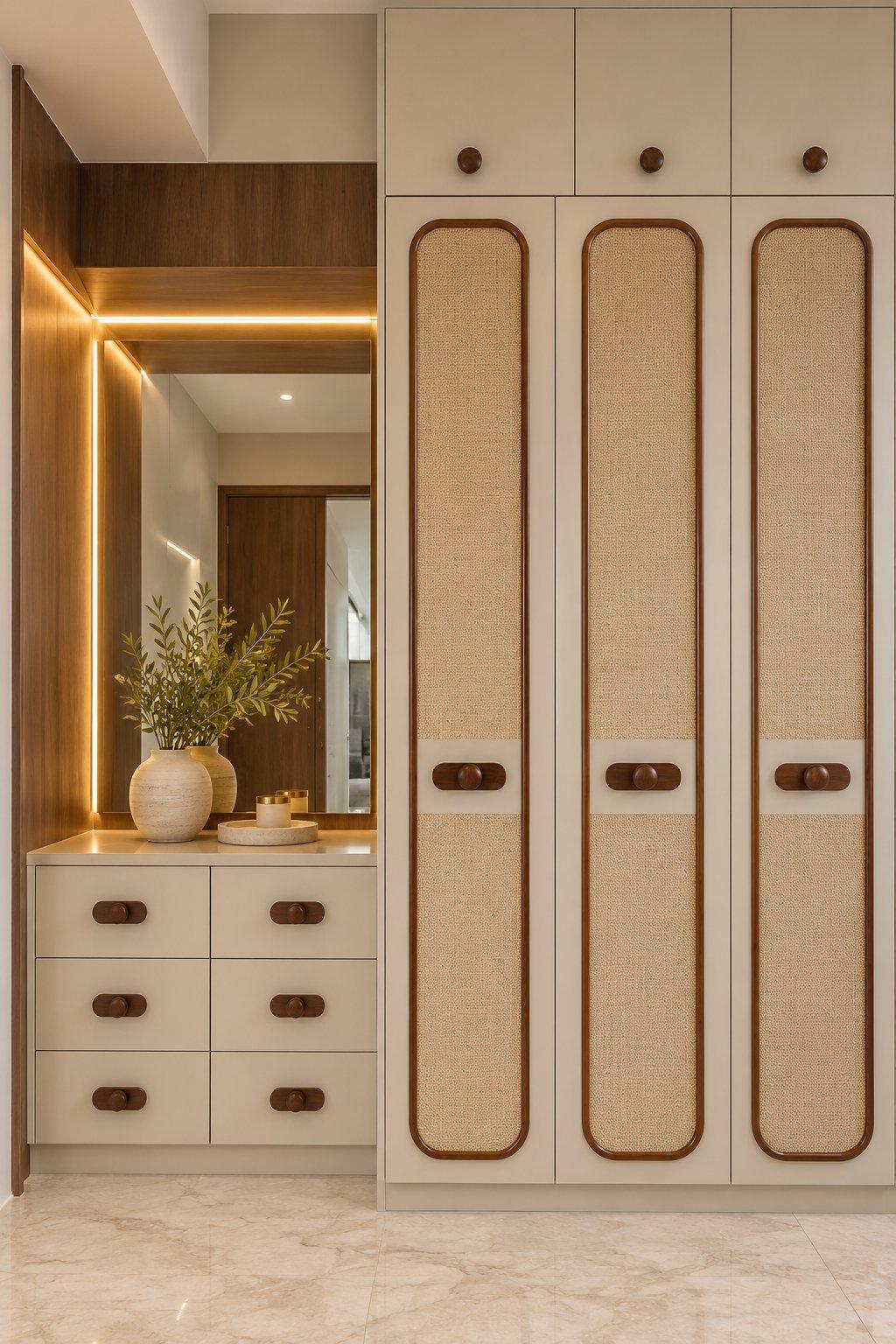
A polished rubber wood frame that covers the joint where two laminates meet — perfect for curved and geometric designs, like a rattan-look panel framed in cream. Usually ₹5,000–10,000 extra.

2026 wardrobe design idea: cream wardrobe with rattan-look laminate panels framed in curved rubber wood trim, beside a lit dresser — Willow Interiors concept render
Concept render · Willow Interiors, 2026

How do you hide the joint between two laminates on a wardrobe shutter?

For a straight joint, use a T-trim. For a curved or geometric joint, fix a thin rubber wood frame over it — cut to the exact shape, nailed on and polished. It hides the dark gap where the two laminates meet and becomes part of the design.

T-trim or wooden trim: which is better for laminate joints?

A T-trim is ideal when the joint is a straight line. When the joint curves — arches, rounded frames, uneven shapes — a CNC-cut rubber wood trim is the best method.

How is a curved wooden trim on a wardrobe made?

It is cut from a 12 mm rubber wood board to the exact shape of the joint, fixed onto the shutter with nails, and polished.

  • Cut the shape from 12 mm rubber wood — a CNC machine follows any curve exactly.
  • Choose the edge profile: bead, curved and many other profiles can be cut by CNC.
  • Nail it onto the shutter over the laminate joint.
  • Polish it to the shade you want.

How much does a wooden trim on a wardrobe cost?

Usually ₹5,000–10,000 extra for a wardrobe — a rubber wood board costs about ₹3,000–3,500 and CNC cutting about ₹2,000, depending on the design.

Can a wooden trim be added to a single-laminate wardrobe?

Yes. Even with one laminate and no joint to hide, a wooden trim in any shape works as a layer on top of the shutter — the same idea as an overlay — and gives the wardrobe a premium look.

Do you need a big budget for a premium-looking wardrobe?

No. Most of what makes a wardrobe look premium is the design, not the price of the materials — a wooden trim, an overlay, a grooved veneer or a designer skirting each adds only a few thousand rupees to a regular laminate wardrobe.

This is how we work as an affordable-luxury studio: we spend days working out how a design can look luxurious while staying within budget.

Cost at a glance

Rubber wood board (12 mm)≈ ₹3,000–3,500
CNC cutting≈ ₹2,000
Typical extra for the wardrobe≈ ₹5,000–10,000

Bangalore prices, October 2026. Depends on the design.

Sculpted wooden shapes on a matte wardrobe

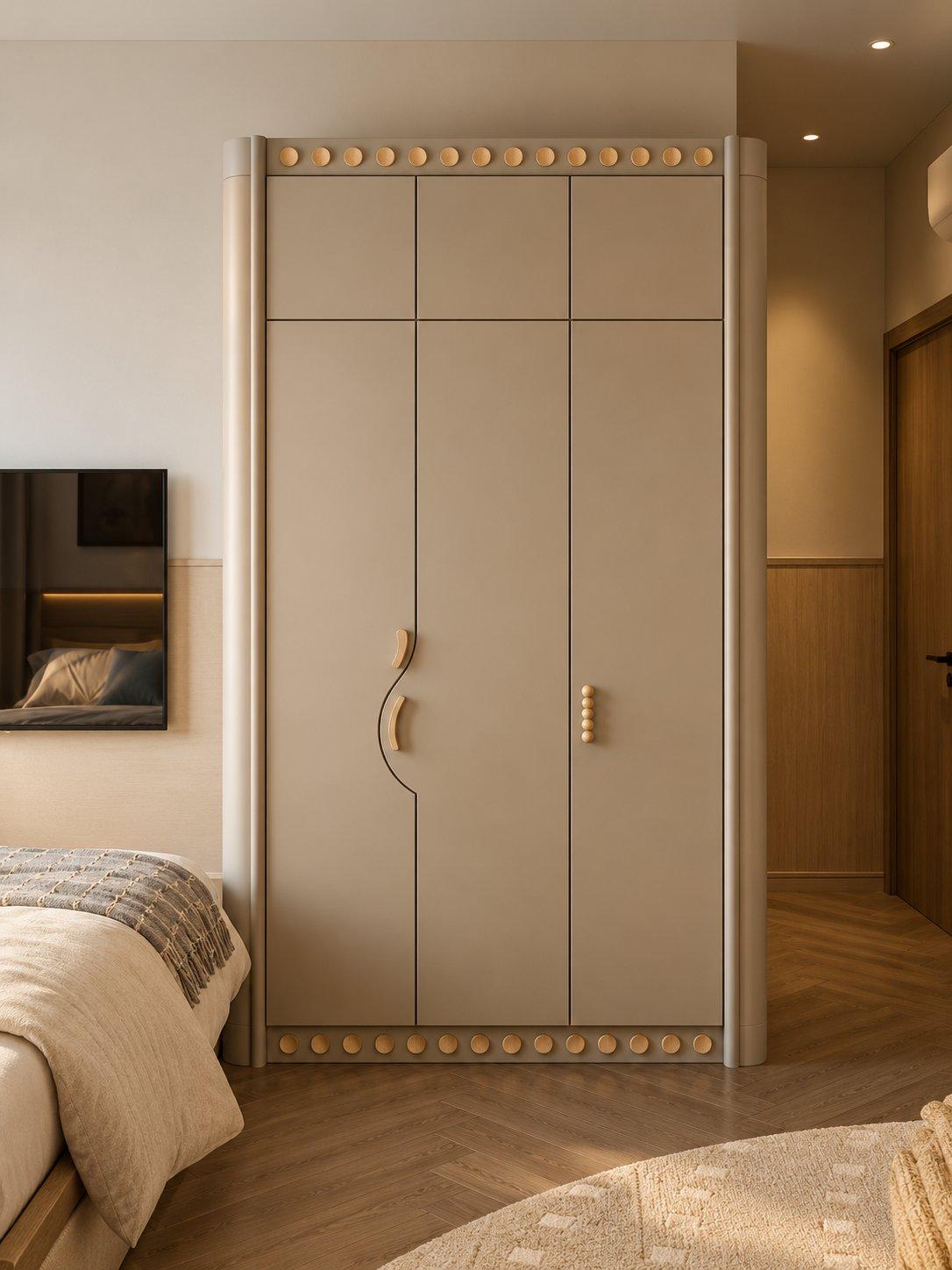
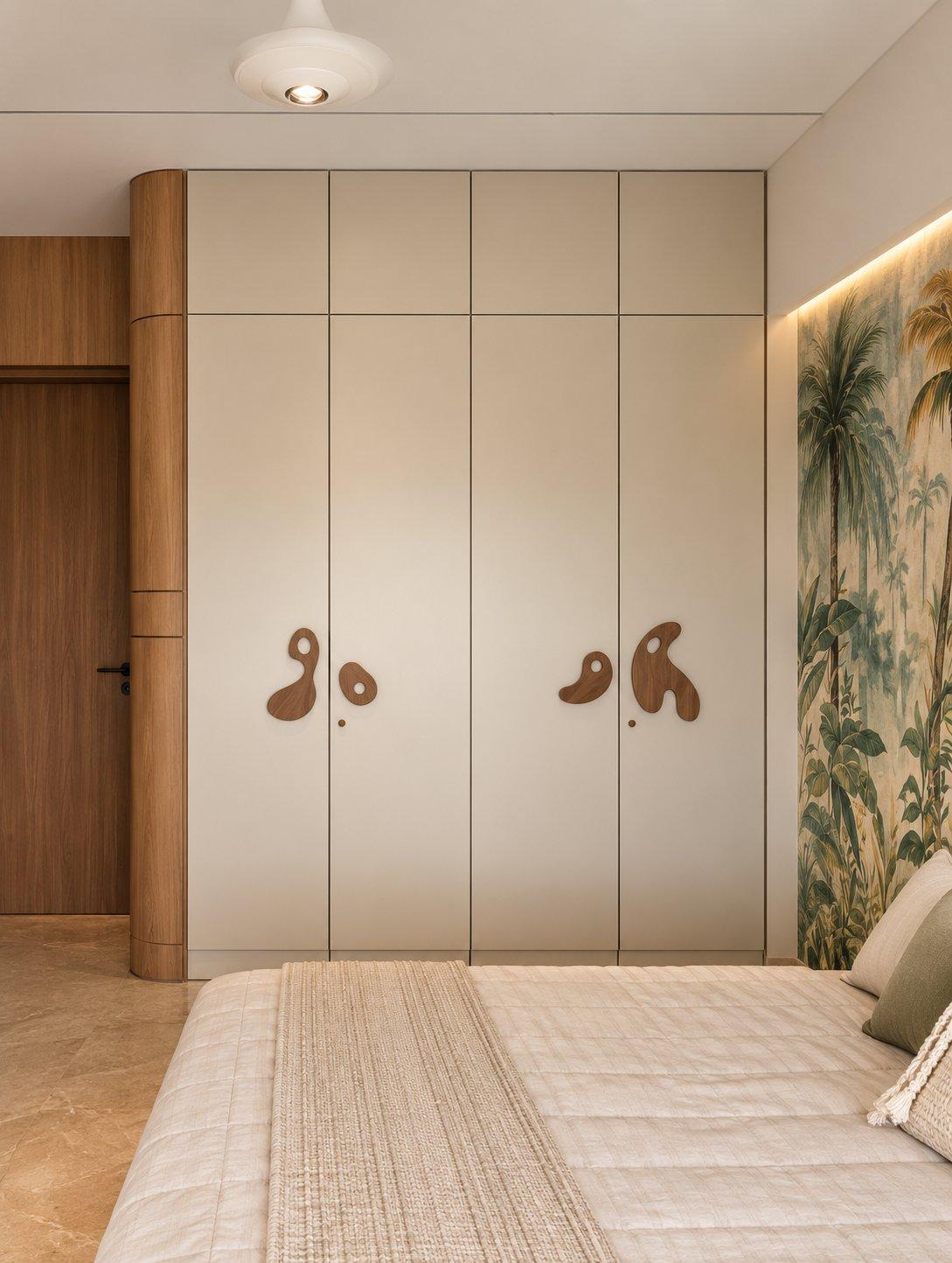
A plain matte pastel wardrobe with a few custom-cut wooden shapes — asymmetric, playful, any form — fixed on the shutters with the handle set into them. Quirky, eye-catching and entirely your own.

2026 wardrobe design idea: matte cream wardrobe with sculpted wooden handles in playful shapes — Willow Interiors concept render
Concept render · Willow Interiors, 2026

How do you make a wardrobe look quirky but still elegant?

Keep the wardrobe calm — a plain matte laminate in a soft pastel — and let a few custom-cut wooden shapes on the shutters carry the personality. The plain base keeps it elegant; the shapes make it fun and eye-catching.

Can you get custom-made wardrobe handles?

Yes. Any shape can be cut from rubber wood or natural wood from a local wood shop, using a CNC machine, then the edges are rounded and sanded smooth. Any size and any thickness works.

How are sculpted wooden shapes added to a wardrobe shutter?

Like an overlay: the wooden shape is fixed on top of the shutter, and a handle is added on top of the shape — so the shape itself does not have to work as the handle.

  • Asymmetric and unusual shapes work best — they look intentional and playful.
  • Shapes can be layered, with a second piece on top of the first for more depth.
  • Use them on a few shutters, not all — a little goes a long way.

Which laminate suits a wardrobe with designer handles?

A plain matte laminate in a soft pastel shade. It keeps the background quiet so the handles stand out, instead of competing with a patterned or glossy surface.

Matte or glossy laminate: which is better for wardrobes?

Matte, any day — especially on a large surface like a wardrobe, and especially if a window, balcony or door is opposite it, because gloss reflects everything. Glossy laminate looks dated; its only advantage is that it wipes clean easily.

If you do want a glossy finish (it is more common in kitchens, for easy cleaning), choose in this order of preference: acrylic first; then PU-finish laminate (a laminate, not PU paint); then a thicker glossy PVC laminate; and a thicker glossy laminate only as the last option.

How much do custom wooden handles cost?

About ₹300–600 per handle, depending on the wood and the polish. Offcuts from local wood shops work well and keep the cost down.

Cost at a glance

WoodRubber wood or natural wood offcuts
Cost per sculpted handle≈ ₹300–600

Bangalore prices, October 2026. Depends on the wood and polish.

How can you make a wardrobe look premium on a budget?

Keep a regular laminate wardrobe and upgrade one detail. Each of these adds between a few hundred rupees and about ₹16,000 — far less than a luxury wardrobe — and choose matte over glossy laminate.

IdeaCost
Sculpted wooden handles₹300–600 per handle
Designer skirting and loft fillerUp to ₹1,000
Printed laminateUp to ₹2,000 per sheet
Curved wooden trim₹5,000–10,000
Layered overlay₹10,000–12,000
Grooved veneer instead of laminate≈ ₹16,000 (8 × 10 ft)

Bangalore prices, October 2026. Extra cost over a regular laminate wardrobe.

Want one of these in your home? We’ll tell you what it costs for your size.